
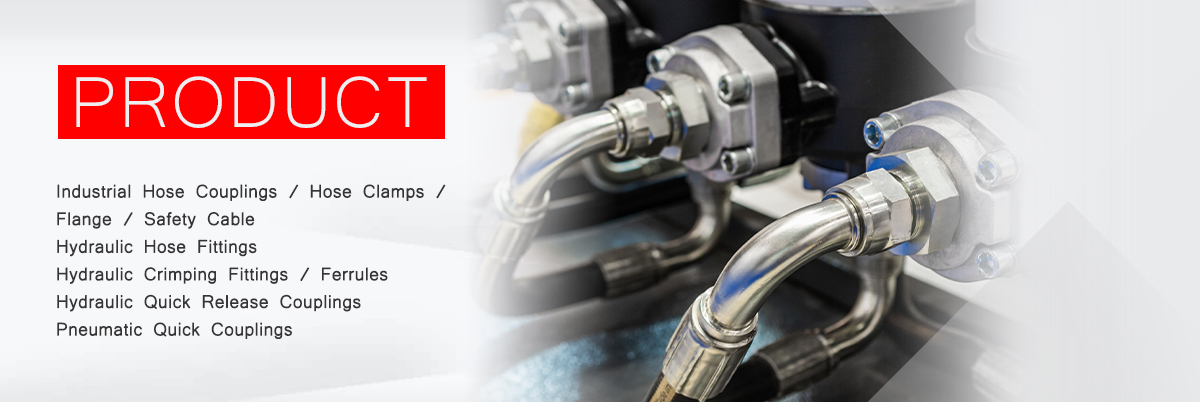
Hydraulic crimp fittings create a permanent mechanical connection between a hydraulic hose and another component within a fluid power system. The hose-tail end is inserted into a compatible hydraulic hose and secured with a ferrule, while the opposite end connects to a pipe, valve, cylinder, pump, manifold, or other hydraulic component.
We manufacture one-piece and two-piece configurations in carbon steel and stainless steel for construction equipment, agricultural machinery, mining systems, power generation equipment, industrial machinery, forestry equipment, and selected oil and gas applications.
Different thread profiles, hose-tail dimensions, ferrules, materials, and connection ends are available according to the hose construction and system requirements. Products can be manufactured to internationally recognized specifications, including ISO, SAE, DIN, BSP, and NPT standards, depending on the fitting type and customer requirements.
For customers requiring non-standard dimensions or application-specific connections, custom hydraulic crimp fitting development can also be evaluated based on drawings, samples, hose specifications, and operating information.What Is a Hydraulic Crimp Fitting?
A hydraulic hose crimp fitting is designed to create a secure connection between a flexible hydraulic hose and a rigid fluid power component.
The fitting normally consists of two functional sections:
- The hose-tail section is inserted into the hydraulic hose.
- The connection end attaches to another part of the hydraulic system through a thread, flange, tube connection, or other interface.
- A ferrule is positioned around the exterior of the hose and compressed using a hydraulic crimping machine. The controlled deformation of the ferrule secures the hose around the fitting stem and helps create a stable assembly.
- The fitting, ferrule, hose, and crimping dimensions must be treated as one complete system. A visually similar component may not provide the same dimensional compatibility or assembly performance.
Crimped hose assemblies are used because they can provide:
- Secure hose retention
- Consistent assembly dimensions
- Efficient production and replacement
- Compact connection geometry
- Compatibility with different hydraulic components
- Reliable routing in mobile and industrial equipment
The final performance of the assembly depends on proper product selection, component compatibility, crimping equipment, tooling, assembly procedures, and inspection.
One-Piece and Two-Piece Crimping Fittings
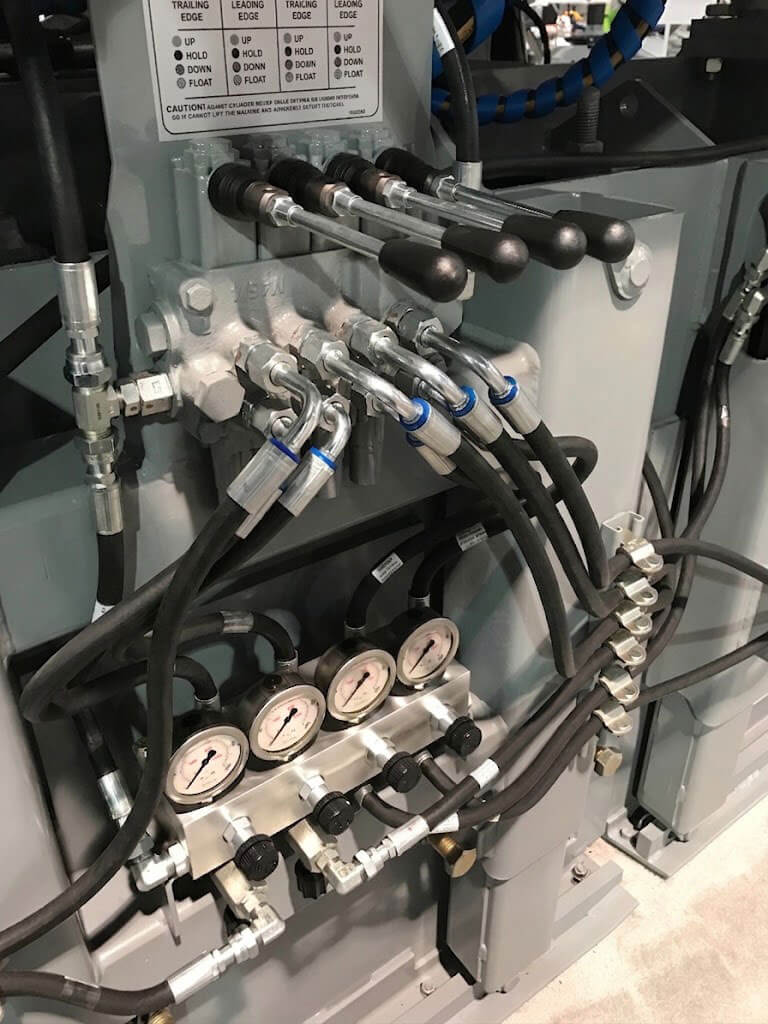
Hydraulic hose crimp fittings are generally classified as one-piece or two-piece products according to how the nipple and ferrule are supplied and assembled.
Neither design is universally better. The correct option depends on the hydraulic hose, assembly process, inventory strategy, application, and customer requirements.
One-Piece Crimp Fittings
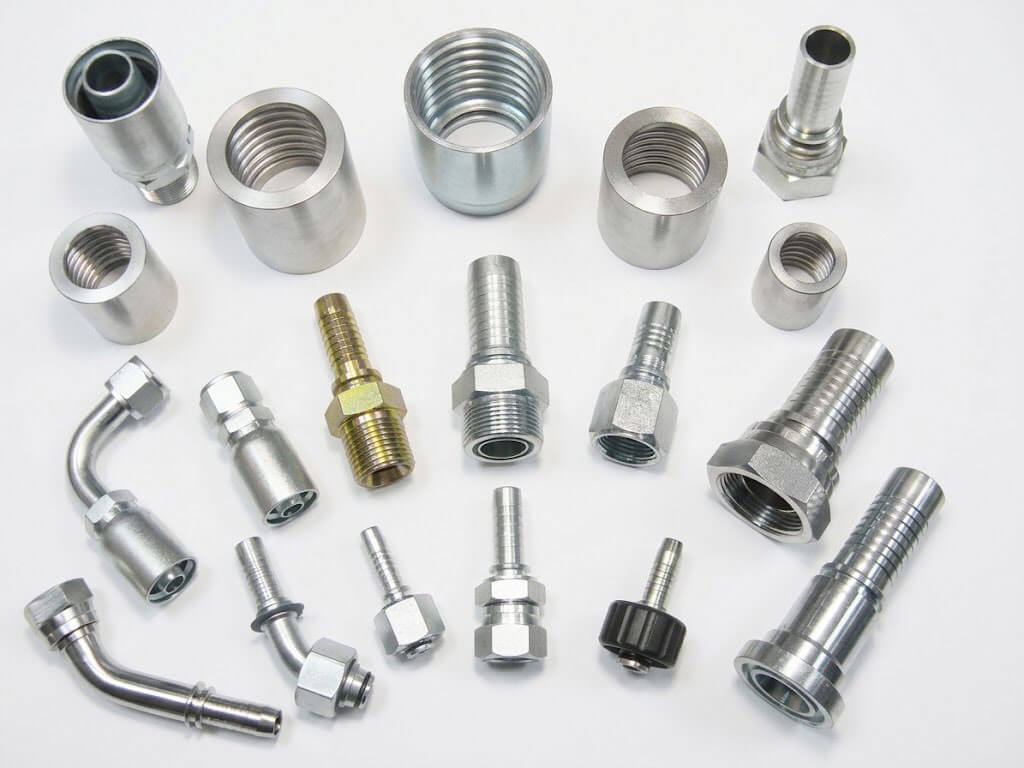
A one-piece fitting, also known as a 1PC fitting, combines the nipple and ferrule into an integrated product.
The ferrule is pre-attached to the fitting body, allowing the assembler to insert the prepared hose and complete the crimping process using the specified tooling and crimp diameter.
One-piece designs may offer the following advantages:
- Simplified component management
- Fewer loose parts during assembly
- Faster fitting and ferrule selection
- Reduced risk of pairing the wrong ferrule
- Efficient production for compatible hose series
- Convenient inventory control
A 1PC product should only be used with hoses confirmed to be compatible with its stem, ferrule, insertion depth, and crimping specification.
An integrated ferrule does not eliminate the need to verify the hose manufacturer, hose series, reinforcement layers, wall thickness, and required crimp diameter.
Two-Piece Crimp Fittings
A two-piece fitting, also known as a 2PC fitting, consists of a separate nipple and ferrule.
The assembler selects the nipple and ferrule independently according to the hose construction and application requirements.
Two-piece configurations may provide:
- Greater flexibility across different hose types
- More ferrule options for varying hose constructions
- Independent replacement of nipples and ferrules
- Broader component combinations
- Flexibility for specialized assembly requirements
- Simplified adaptation to regional hose preferences
Two-piece products are often considered when one nipple design must be paired with different ferrules or when the hose construction requires a specific sleeve design.
The selected nipple and ferrule must still be dimensionally compatible and approved for use together.
Choosing Between 1PC and 2PC Fittings
A one-piece design is generally recommended when the integrated ferrule is compatible with the intended hose and the assembler prioritizes speed, simplicity, and component control.
A two-piece design may be more suitable when greater assembly flexibility is required or when separate ferrules are needed to accommodate different hose constructions.
Before choosing between the two configurations, confirm:
- Hose manufacturer and series
- Hose inside and outside diameter
- Number and type of reinforcement layers
- Skive or non-skive requirements
- Fitting stem dimensions
- Ferrule dimensions
- Crimping equipment and tooling
- Specified crimp diameter
- Application pressure and temperature
- Assembly inspection procedures
The selection should be based on a validated hose assembly rather than purchasing preference alone.
Carbon Steel and Stainless Steel Material Options
The body material influences mechanical strength, corrosion resistance, environmental suitability, media compatibility, and expected service life.
Our hydraulic crimp fittings are available in carbon steel and stainless steel.
Carbon Steel Crimp Fittings
Carbon steel is commonly used for general hydraulic machinery and fluid power systems requiring dependable mechanical properties and cost-effective production.
Typical applications include:
- Construction machinery
- Agricultural equipment
- Mining equipment
- Hydraulic power units
- Industrial machinery
- Forestry equipment
- Power generation systems
The appropriate surface treatment should be selected according to humidity, outdoor exposure, industrial contamination, maintenance conditions, and customer specifications.
Customers should also consider whether the transported hydraulic fluid and surrounding environment are compatible with the selected material and finish.
Stainless Steel Crimp Fittings
Stainless steel can be considered for applications requiring enhanced corrosion resistance or operation in demanding environments.
A stainless steel hydraulic hose crimp fitting may be suitable for systems exposed to moisture, aggressive surroundings, repeated cleaning, or operating media that are not suitable for standard carbon steel.
The correct stainless steel grade should be selected according to:
- Fluid properties
- Operating temperature
- Environmental exposure
- Corrosion risk
- System pressure
- Required service life
- Customer or project specifications
Stainless steel should not be assumed to be universally compatible with every chemical, gas, or hydraulic fluid. The complete assembly, including the hose, ferrule, seals, and connected components, must be evaluated.
International Thread and Connection Standards
Hydraulic systems use different connection standards according to equipment origin, industry, market, and application.
Our crimping fittings can be manufactured according to internationally recognized specifications, including ISO, SAE, DIN, BSP, and NPT requirements, depending on the product type and customer specifications.
ISO Connections
ISO standards cover various dimensional, performance, and connection requirements used in international hydraulic systems.
Customers should identify the exact ISO standard rather than requesting an ISO fitting without additional information, because multiple connection structures and dimensional series may fall under the ISO system.
SAE Connections
SAE hydraulic connections are widely used in mobile equipment, industrial machinery, construction systems, and North American fluid power applications.
The applicable thread, sealing surface, tube size, and connection configuration should be confirmed before production.
DIN Connections
DIN-based connections are frequently used in European hydraulic systems, machinery, tube fittings, and industrial equipment.
Customers should provide the corresponding DIN specification, tube series, sealing style, and dimensional requirements.
BSP Connections
BSP connections may use parallel or tapered thread forms.
Because BSPP and BSPT connections differ in thread and sealing design, customers should identify the required thread form and sealing method before ordering.
NPT Connections
NPT threads create a tapered threaded connection commonly used in North American industrial and fluid-handling systems.
The nominal thread size, thread engagement, sealing method, material, and application requirements should be confirmed before assembly.
Visually similar threads are not necessarily interchangeable. Thread diameter, pitch, taper, sealing surface, and connection geometry must all be checked.
Why Fittings, Ferrules and Hoses Must Be Matched
A crimped hose assembly relies on controlled interaction between the fitting stem, hose wall, reinforcement layers, ferrule, and crimping force.
Due to manufacturing tolerances and proprietary product designs, the crimping-end dimensions of hydraulic hose fittings may differ between manufacturers.
These differences may include:
- Stem outside diameter
- Serration profile
- Stem insertion length
- Ferrule inside diameter
- Ferrule wall thickness
- Ferrule length
- Crimping zone
- Material hardness
- Crimp diameter recommendation
Using a nipple from one supplier and a ferrule from another may create dimensional uncertainty, even when the parts appear similar.
An incorrect combination may result in:
- Insufficient hose retention
- Excessive hose compression
- Damage to reinforcement layers
- Restricted internal flow
- Ferrule deformation
- Hose cover damage
- Assembly leakage
- Premature hose separation
For consistent assembly performance, hydraulic hose fittings and ferrules should generally be sourced as a matched combination from the same manufacturer or used according to a validated assembly specification.
The hose must also be confirmed as compatible with the selected nipple and ferrule.
Hose Assembly and Crimping Considerations
Correct product selection is only one part of producing a dependable hydraulic hose assembly.
The assembly process should follow the specifications established for the hose, fitting, ferrule, and crimping system.
Hose Identification
Confirm the hose manufacturer, product series, nominal size, reinforcement structure, and applicable standard.
Hoses with the same nominal inside diameter may have different outside diameters, wall thicknesses, reinforcement layers, and crimping requirements.
Hose Preparation
Depending on the assembly design, the hose may require external skiving, internal skiving, both, or no skiving.
Incorrect preparation can damage the hose, prevent proper insertion, or affect the ferrule’s engagement with the reinforcement layers.
Fitting Insertion
The fitting should be inserted to the specified depth.
Insufficient insertion may reduce retention, while incorrect positioning may affect sealing or cause the ferrule to be crimped in the wrong location.
Crimp Diameter
The finished crimp diameter must follow the approved specification for the complete assembly.
Excessive compression may damage the hose or restrict the fitting bore. Insufficient compression may result in leakage or hose separation.
Assembly Inspection
The finished assembly should be inspected according to the manufacturer’s procedures.
Inspection may include:
- Crimp diameter verification
- Insertion-depth confirmation
- Ferrule position inspection
- Visual examination of the hose cover
- Thread and sealing-surface inspection
- Internal bore inspection
- Cleanliness verification
- Required pressure or leakage testing
Inspection requirements should be defined according to the application and customer specifications.
Custom Hydraulic Hose Fitting Development
Standard fittings may not meet every hose construction, machinery layout, installation space, or replacement requirement.
As a hydraulic hose coupling manufacturer, we can evaluate custom products based on technical drawings, reference samples, existing part numbers, or application information.
Custom development may include:
- Modified hose-tail dimensions
- Different stem lengths
- Custom serration profiles
- Special ferrule dimensions
- Customer-specific thread connections
- Alternative sealing surfaces
- Modified fitting angles
- Straight, elbow, or other body configurations
- Carbon steel or stainless steel construction
- Application-specific identification
- Special packaging requirements
A custom hydraulic hose fitting may be required when customers need to replace an obsolete component, match proprietary machinery, integrate a new hose series, or consolidate multiple connections into a single fitting design.
Information Required for Custom Development
To evaluate a custom project, provide as much of the following information as possible:
- Technical drawing
- Reference sample
- Existing product number
- Hose manufacturer and series
- Hose inside and outside diameter
- Hose reinforcement construction
- Required ferrule design
- Connection standard
- Thread size and sealing method
- Normal and maximum pressure
- Operating temperature
- Hydraulic fluid or media
- Body material
- Fitting angle or orientation
- Annual or order quantity
- Inspection requirements
- Material certificate requirements
Complete information allows the hydraulic fitting manufacturer to review dimensional compatibility, manufacturing feasibility, material selection, and quotation conditions more accurately.
Industrial Applications
Hydraulic hose couplings are used wherever flexible hoses must connect pumps, cylinders, valves, motors, manifolds, and other fluid power components.
Construction Equipment
Excavators, loaders, cranes, lifting equipment, and other construction machinery depend on hydraulic hose assemblies to transfer power between pumps, valves, cylinders, and attachments.
Fittings used in these systems must be selected according to pressure, vibration, movement, hose routing, environmental exposure, and maintenance requirements.
Agricultural Machinery
Tractors, harvesters, sprayers, irrigation equipment, and agricultural attachments use hydraulic hoses for lifting, steering, implement control, and auxiliary power.
The assembly should account for outdoor exposure, vibration, dust, movement, and repeated equipment connection.
Mining Equipment
Mining machinery operates in environments involving vibration, contamination, abrasive materials, heavy loads, and demanding maintenance conditions.
Hose assemblies should be evaluated according to system pressure, routing, abrasion exposure, installation space, and the consequences of downtime.
Oil and Gas Applications
Selected hydraulic systems within oil and gas operations use hose assemblies for equipment actuation, maintenance, testing, and fluid power control.
Product selection must consider the specific operating environment, media, pressure, temperature, project specifications, and applicable industry requirements.
No fitting should be assumed suitable for hazardous or regulated applications without a complete technical review and the required approvals.
Power Generation
Hydraulic hose assemblies can be used in power generation equipment, maintenance systems, control mechanisms, lubrication equipment, and auxiliary machinery.
Material, connection standard, cleanliness, documentation, and reliability requirements may vary according to the power generation process and project specifications.
Industrial Machinery
Manufacturing equipment, presses, machine tools, automation systems, and hydraulic power units use flexible hose assemblies to connect moving and fixed components.
Proper fitting selection can support efficient installation, maintenance access, equipment movement, and system reliability.
Forestry Equipment
Forestry machinery often operates under continuous movement, vibration, outdoor exposure, and demanding mechanical conditions.
Hydraulic fittings and hoses should be selected according to pressure, routing, abrasion, impact risk, environmental exposure, and maintenance frequency.
How to Select the Right Crimp Fitting
The correct product should be selected according to the complete hydraulic hose system rather than one dimension or part number alone.
Confirm the Hose Specification
Identify the hose manufacturer, series, nominal size, reinforcement structure, and applicable hose standard.
This information determines which nipple and ferrule configurations may be compatible.
Choose a 1PC or 2PC Design
Use a one-piece design when the integrated ferrule is validated for the selected hose and simplified assembly is preferred.
Consider a two-piece design when separate ferrule selection is needed for different hose constructions or assembly requirements.
Identify the Connection Standard
Confirm whether the fitting requires an ISO, SAE, DIN, BSP, NPT, or customer-specific connection.
Provide the complete standard number, thread size, sealing method, and dimensional requirements whenever possible.
Confirm the Operating Conditions
Provide the normal operating pressure, maximum pressure, impulse conditions, minimum temperature, maximum temperature, and hydraulic media.
These conditions affect the hose, fitting, ferrule, material, and assembly requirements.
Select the Body Material
Choose carbon steel or stainless steel based on mechanical requirements, corrosion exposure, media compatibility, environmental conditions, and expected service life.
Verify the Crimping Specification
Confirm the required crimping machine, die set, finished crimp diameter, insertion depth, and inspection process.
Do not assume that components from different manufacturers use the same crimping specification.
Quality Management and Manufacturing Support
Selecting a hydraulic hose coupling supplier involves more than comparing fitting dimensions and unit prices.
Industrial buyers should also evaluate material traceability, dimensional consistency, manufacturing control, technical communication, documentation, and the supplier’s ability to support standard and custom requirements.
ISO 9001 Quality Management
Our ISO 9001 quality management system supports documented production procedures, process control, inspection management, traceability, and continuous improvement.
Material Certificates
Material certificates can be provided according to product specifications and order requirements.
These documents help customers verify the specified body material and support internal quality-control, procurement, and project-documentation procedures.
Digital Transformation
Digital systems are progressively integrated into appropriate production and management processes to improve information accuracy, process visibility, manufacturing coordination, and order tracking.
AI Technology Integration
AI technologies are applied to suitable operational and administrative processes, including information analysis, workflow optimization, and data processing.
AI supports operational efficiency but does not replace technical review, dimensional inspection, manufacturing control, or hose assembly validation.
Frequently Asked Questions About Hydraulic Crimp Fittings
When Should I Use 1PC or 2PC Crimping Fittings?
One-piece fittings are recommended for compatible hose types when an integrated ferrule design can simplify component selection and support faster assembly.
Because the nipple and ferrule are supplied together, one-piece products can reduce the possibility of pairing incompatible components.
Two-piece fittings are recommended when greater assembly flexibility is required. Separate nipples and ferrules allow customers to select different ferrule configurations for various hose constructions.
The final selection should be based on the hose manufacturer, hose series, reinforcement structure, fitting dimensions, ferrule design, and validated crimping specification.
Are Your Crimping Fittings Manufactured According to International Standards?
Yes. Our crimping fittings can be manufactured according to internationally recognized standards, including ISO, SAE, DIN, BSP, and NPT specifications, depending on the fitting type and customer requirements.
Following recognized connection standards helps support dimensional compatibility, reliable installation, and integration with industry-standard hydraulic hose systems.
Customers should provide the exact standard, thread type, sealing method, nominal size, and application requirements because each standards system contains multiple connection configurations.
Why Must Hydraulic Hose Fittings and Ferrules Be Matched?
The crimping-end dimensions of hydraulic hose fittings may vary slightly between manufacturers due to production tolerances and proprietary product designs.
Ferrule dimensions, wall thickness, length, material, and crimping zones may also differ.
Using components that have not been designed or validated together can result in an incorrect finished crimp diameter, insufficient retention, excessive compression, hose damage, leakage, or assembly failure.
For more consistent fit and crimping performance, it is recommended to use fittings and ferrules from the same manufacturer and confirm their compatibility with the selected hose.
Can You Produce Custom Hydraulic Crimp Fittings?
Yes. Custom products can be evaluated based on technical drawings, reference samples, hose specifications, connection standards, application requirements, and estimated quantities.
Customization may include the fitting stem, ferrule, thread, connection end, material, angle, overall dimensions, and product identification.
Tooling, sample production, testing, and approval may be required depending on the design.
What Information Is Required for a Quotation?
To prepare an accurate quotation, provide:
- Fitting type
- One-piece or two-piece requirement
- Hose manufacturer and series
- Hose size and reinforcement structure
- Connection standard
- Thread size
- Body material
- Operating pressure
- Operating temperature
- Hydraulic fluid
- Required quantity
- Drawing, sample, or reference part number
Providing complete technical information reduces the risk of quoting an incompatible product.
Request a Hydraulic Crimp Fitting Quotation
To receive an appropriate product recommendation, provide the required hose specification, 1PC or 2PC configuration, thread or connection standard, operating pressure, temperature, hydraulic media, body material, quantity, and application.
Technical drawings, reference samples, existing product numbers, hose data sheets, and crimping specifications can help our team verify the connection and assembly requirements.
Contact our hydraulic hose coupling supplier team to discuss standard products, material options, matched nipple and ferrule combinations, or custom hydraulic crimp fitting requirements.
