
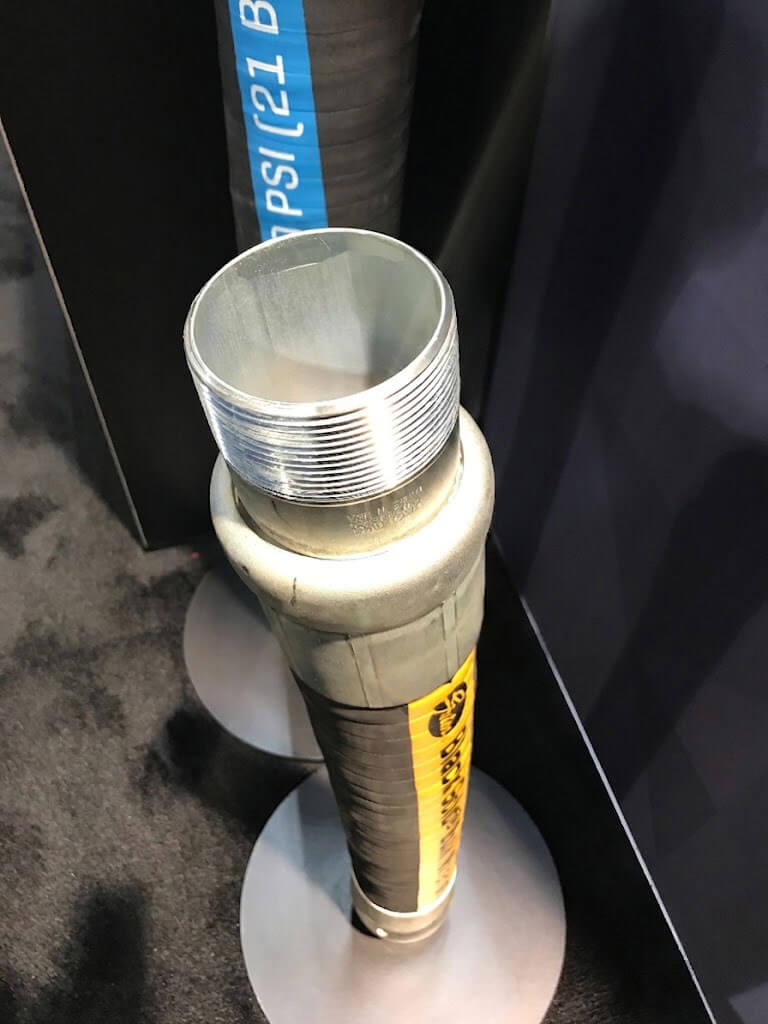
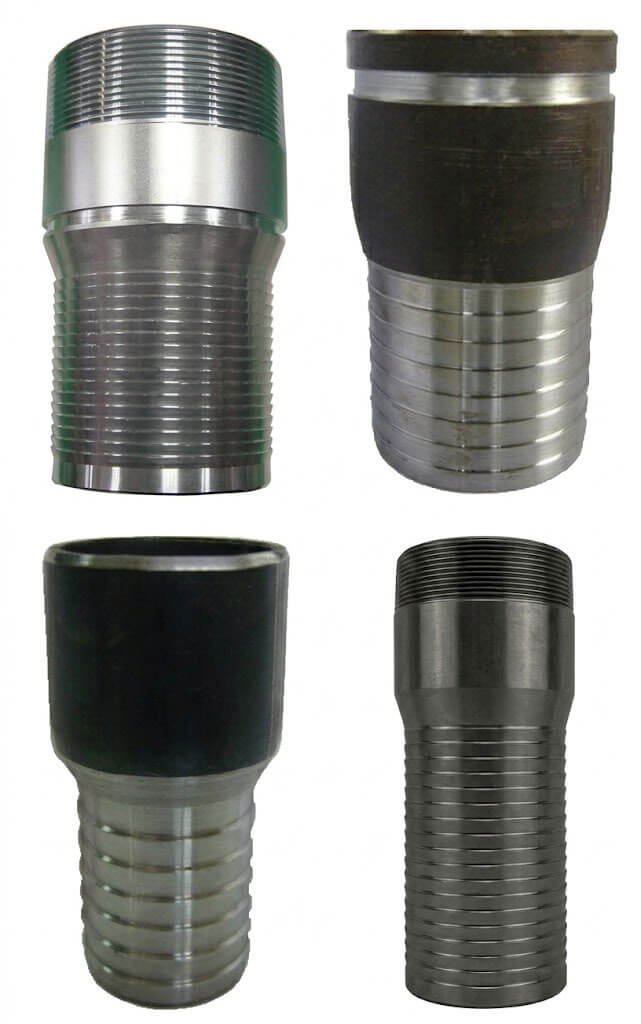
King Combination Nipples provide a practical connection between industrial hoses and piping systems in low-pressure, high-flow liquid and gas applications. Their hose-tail design allows the fitting to be installed into a compatible hose, while the opposite end connects to threaded, grooved, welded, or other piping interfaces.
We manufacture KC nipples in steel, stainless steel, and brass to support different operating media and environmental conditions. Standard configurations are available for common industrial requirements, while custom dimensions can be developed according to customer drawings, hose sizes, connection specifications, and application needs.
Our products are used across agriculture, forestry, construction, mining, energy, oil and gas, and maintenance operations where efficient media transfer and dependable hose connections are required.
What Is a King Combination Nipple?
A King Combination Nipple is an industrial hose fitting designed to connect a flexible hose to a pipe, valve, manifold, tank, pump, or other fluid-handling component.
One end normally features a hose shank or serrated tail that is inserted into the hose. The fitting is then secured using an appropriate clamp, crimping method, or other approved retention system. The opposite end provides the connection required by the piping system.
Depending on the selected configuration, the piping end may be:
- Threaded
- Grooved
- Weld-on
- Crimp-style
- Customer-specific
This combination of a hose connection and a piping connection makes the fitting suitable for suction, discharge, transfer, and general industrial hose assemblies.
A KC nipple is commonly selected when a system requires relatively high flow at low operating pressure and when hoses need to be connected to different piping interfaces without unnecessarily complex assemblies.
Designed for Low-Pressure, High-Flow Applications
King Combination Nipples are primarily intended for systems that transfer large volumes of compatible liquid or gas at relatively low pressure.
The internal flow path and hose-tail connection make them suitable for applications involving:
- Water transfer
- Oil transfer
- Industrial waste discharge
- Liquid suction and discharge
- General industrial fluid handling
- Compatible low-pressure gas transfer
The actual performance of an assembly depends on more than the fitting itself. Hose construction, clamp or crimp selection, connection size, operating pressure, temperature, media compatibility, installation quality, and system movement must all be considered.
Before selecting an industrial hose nipple, users should confirm:
- Normal operating pressure
- Maximum system pressure
- Operating temperature
- Required flow rate
- Hose inside diameter
- Hose wall construction
- Transferred liquid or gas
- Body material compatibility
- Pipe connection type
- Required retention method
- Environmental exposure
A fitting should not be selected solely by nominal size or external appearance. The complete hose assembly must be evaluated as one operating system.
Available King Nipple Connection Styles
Industrial piping systems use different connection methods depending on their equipment design, maintenance requirements, installation environment, and regional standards.
We offer King nipples in several configurations to support these requirements.
Threaded King Combination Nipples
Threaded configurations allow the hose assembly to connect with compatible valves, pumps, pipes, manifolds, and equipment ports.
The thread specification should be confirmed before ordering because visually similar thread forms may differ in diameter, pitch, sealing method, or dimensional standard.
Customers should provide the required thread type, nominal size, male or female configuration, and available technical drawing whenever possible.
Grooved King Nipples
Grooved connections are suitable for piping systems designed around compatible grooved couplings.
This configuration can support efficient installation and maintenance in fluid-transfer systems where grooved piping components are already used.
The groove profile, pipe size, coupling compatibility, gasket material, and operating conditions should be verified before installation.
Serrated Hose-Tail Designs
A serrated hose tail provides multiple contact points between the fitting and the internal surface of the hose.
The serrations help support mechanical engagement, but the hose must still be secured using a clamp, crimp sleeve, or another retention method suitable for the hose construction and operating conditions.
The hose inside diameter and fitting outside diameter should be properly matched to avoid difficult installation, insufficient retention, or damage to the hose lining.
Weld-On King Nipples
Weld-on configurations allow the fitting to become part of a fabricated pipe, tank, manifold, or equipment assembly.
The selected body material must be compatible with the base component and the intended welding procedure.
Welding should be performed by qualified personnel using an appropriate process to avoid distortion, cracking, contamination, or damage to the hose-tail area.
Crimp-Style King Nipples
Crimp-style products are designed for hose assemblies secured with compatible ferrules or sleeves.
The nipple, ferrule, hose, and crimping specification must be evaluated as a complete assembly. Incorrect crimp diameter or incompatible components may affect hose retention and sealing performance.
Customers requesting a crimp configuration should provide the hose manufacturer, hose series, inside diameter, outside diameter, reinforcement structure, and assembly requirements.
Material Options for Different Operating Media
Material selection affects corrosion resistance, mechanical strength, media compatibility, environmental durability, and product life.
Our King Combination Nipples are available in steel, stainless steel 304, stainless steel 316, and brass.
Steel King Combination Nipples
Steel provides dependable mechanical strength and is commonly used for general industrial fluid-transfer systems, construction equipment, agricultural machinery, mining operations, and maintenance applications.
The suitability of steel depends on the transferred media and the level of environmental exposure. Surface protection requirements should be discussed when the fitting will operate outdoors, in humid conditions, or near corrosive substances.
Stainless Steel 304 King Nipples
Stainless steel 304 provides improved corrosion resistance compared with standard carbon steel and is suitable for many industrial liquid-handling environments.
It can be considered when the fitting is exposed to moisture, repeated cleaning, or operating conditions requiring greater resistance to general corrosion.
Final material selection should still account for the specific fluid, temperature, contaminants, and surrounding environment.
Stainless Steel 316 King Nipples
Stainless steel 316 offers enhanced corrosion resistance and is often considered for more demanding industrial environments or media.
For buyers evaluating stainless steel KC nipple options, the choice between grades 304 and 316 should be based on the chemical properties of the media, environmental exposure, required service life, and customer specifications.
Stainless steel alone does not guarantee compatibility with every chemical or fluid. The complete system, including the hose, seals, clamps, and connected equipment, should be reviewed.
Brass King Combination Nipples
Brass provides good machinability and corrosion resistance for many compatible liquid and gas applications.
It may be selected for systems where brass is preferred for media compatibility, installation requirements, or existing piping components.
Before use, customers should confirm whether brass is suitable for the operating fluid, pressure, temperature, and surrounding environment.
Custom KC Nipple Manufacturing
Standard sizes may not match every hose, piping layout, machine design, or replacement requirement.
As a KC nipple manufacturer, we support custom development based on customer drawings, reference samples, dimensional specifications, and application information.
Customisation may include:
- Hose-tail outside diameter
- Hose-tail length
- Serration profile
- Overall fitting length
- Thread specification
- Groove dimensions
- Weld-end dimensions
- Crimp connection design
- Body material
- Wall thickness
- Customer-specific connection geometry
- Product identification or marking
Custom sizing is especially useful when customers need to replace an existing fitting, match a specific hose construction, integrate the product into proprietary equipment, or consolidate several components into one connection.
Information Required for Custom Development
To evaluate a custom request accurately, customers should provide as much of the following information as possible:
- Technical drawing
- Reference sample
- Required connection style
- Hose inside diameter
- Hose outside diameter
- Hose construction
- Nominal pipe size
- Thread or groove specification
- Operating pressure
- Operating temperature
- Transferred liquid or gas
- Required body material
- Assembly method
- Estimated order quantity
- Inspection or documentation requirements
Complete information helps reduce dimensional uncertainty, shorten technical communication, and improve the accuracy of product evaluation and quotation.
Applications of King Combination Nipples
King Combination Nipples are used in industries that require practical hose-to-pipe connections for fluid suction, discharge, transfer, and equipment maintenance.
Agriculture and Forestry
Agricultural and forestry operations frequently use hoses to transfer water, oil, fuel-related media, and other compatible liquids between pumps, tanks, machinery, and field equipment.
King nipples provide a straightforward method of connecting flexible hoses to piping components in irrigation, drainage, water transfer, and general equipment-support systems.
Material and connection style should be selected according to outdoor exposure, transported media, hose type, and maintenance frequency.
Construction Equipment
Construction sites may require temporary or permanent hose connections for water handling, equipment servicing, dewatering, and other low-pressure transfer operations.
A suitable fitting can help maintenance teams assemble or replace hose lines efficiently while matching the available piping interface.
Steel and stainless steel options can be evaluated according to environmental exposure and fluid compatibility.
Energy and Oil & Gas
Energy and oil and gas operations use industrial hoses for various transfer, drainage, maintenance, and waste-handling processes.
Product suitability must be evaluated according to the specific media, pressure, temperature, environmental conditions, and applicable project requirements.
Material compatibility is particularly important because water, oils, industrial waste, and process-related fluids may have significantly different chemical properties.
Maintenance, Repair and Operations
MRO teams frequently need replacement fittings that can connect existing hoses to pumps, valves, tanks, pipes, and production equipment.
Working with an experienced KC nipple supplier can help maintenance personnel verify connection dimensions, body material, hose compatibility, and replacement requirements before ordering.
Custom products can also be evaluated when the original component is unavailable or when an existing system uses a non-standard connection.
Mining
Mining environments may involve water transfer, drainage, industrial waste handling, equipment maintenance, and other demanding hose applications.
Fittings used in these environments should be evaluated for mechanical durability, corrosion exposure, installation conditions, hose retention, and compatibility with the transferred media.
Stainless steel or other material options may be considered when standard steel does not provide sufficient environmental resistance.
How to Select the Right King Combination Nipple
Selecting the correct fitting requires more than identifying the nominal hose size.
The following factors should be confirmed before placing an order.
Hose Dimensions and Construction
Confirm the hose inside diameter, outside diameter, wall thickness, reinforcement structure, and manufacturer specifications.
The hose-tail dimensions must be compatible with the hose and the selected clamp or crimping method.
Connection Type
Identify whether the system requires a threaded, grooved, weld-on, crimp, or customer-specific connection.
For threaded and grooved designs, provide the applicable standard and dimensions rather than relying only on the nominal size.
Operating Media
Confirm whether the system transfers water, oil, industrial waste, gas, or another medium.
The media affects the selection of body material, hose, seals, connected components, and corrosion protection.
Pressure and Temperature
Provide both normal and maximum operating pressure, including any temporary surges.
The minimum and maximum operating temperatures should also be considered because they may affect the hose, fitting material, retention method, and overall assembly.
Material Requirements
Choose steel, stainless steel 304, stainless steel 316, or brass according to the media, environmental exposure, mechanical requirements, and customer specifications.
Material selection should be based on actual operating conditions rather than price alone.
Assembly Method
Confirm whether the fitting will be secured using clamps, ferrules, crimp sleeves, or another approved retention method.
The selected method must be compatible with the hose and fitting geometry.
Quality Management and Manufacturing Support
Selecting a King combination nipple supplier involves evaluating more than the available sizes and quoted price.
Industrial buyers should also review material traceability, production consistency, dimensional control, technical communication, and the supplier’s ability to support standard and custom requirements.
Our manufacturing and management capabilities include the following.
ISO 9001 Quality Management
Our ISO 9001 quality management system supports documented production procedures, process control, inspection management, traceability, and continuous improvement.
Material Certificates
Material certificates can be provided according to product specifications and order requirements.
These documents help customers verify the specified material and support internal quality-control, procurement, and project-documentation processes.
Digital Transformation
Digital systems are progressively integrated into appropriate production and management processes to improve information accuracy, process visibility, manufacturing coordination, and order tracking.
AI Technology Integration
AI technologies are incorporated into suitable operational and administrative processes, including information processing, workflow optimisation, and data analysis.
AI integration supports operational efficiency but does not replace the technical review, manufacturing control, and inspection procedures required for industrial fittings.
Frequently Asked Questions About King Combination Nipples
What Is the Design Principle of a King Combination Nipple?
A King Combination Nipple is designed to create a practical, leak-resistant connection between a flexible hose and a piping system.
The hose shank is inserted into a compatible hose and secured using an appropriate clamp, ferrule, crimp sleeve, or retention method. The opposite end connects to the piping system through a threaded, grooved, welded, crimped, or customized interface.
Reliable performance depends on the compatibility of the fitting, hose, retention method, operating pressure, temperature, and transferred media.
What Media Are King Combination Nipples Commonly Used to Convey?
They are primarily used in low-pressure liquid suction and discharge applications involving media such as water, oil, and compatible industrial waste.
Certain configurations may also be used for compatible low-pressure gases, subject to a complete review of the material, hose, connection method, pressure, temperature, and applicable safety requirements.
Customers should provide detailed media information before ordering because chemical compatibility can vary significantly between steel, stainless steel, brass, and hose materials.
How Should I Choose Between Steel, Stainless Steel and Brass?
Steel is commonly selected for general industrial applications requiring dependable mechanical strength.
Stainless steel 304 can provide improved general corrosion resistance, while stainless steel 316 may be considered for more demanding media or environments.
Brass is suitable for many compatible liquid and gas systems where its corrosion resistance and material properties meet the application requirements.
The final decision should be based on the transferred media, operating temperature, environmental exposure, mechanical requirements, and expected service life.
Are Custom King Nipple Sizes Available?
Yes. Custom dimensions and connection configurations can be evaluated upon request.
Customers should provide a technical drawing, sample, hose dimensions, piping connection requirements, operating media, pressure, temperature, material preference, and estimated quantity.
Tooling, sampling, testing, and approval requirements may apply depending on the complexity of the product.
What Is the General Delivery Lead Time?
Production lead time depends on the product specifications, material, order quantity, customization requirements, and current manufacturing schedule.
The typical lead time is approximately 45 days to two months. Customers should confirm the estimated delivery schedule before placing an order.
Custom-developed products may require additional time for technical review, tooling, sample production, testing, and approval.
Is There a Minimum Order Quantity?
Order requirements depend on the product style, dimensions, material, customization level, and manufacturing conditions.
Under FOB terms, shipments with a total value below USD 6,000 will incur additional domestic charges. These may include documentation fees, bank handling fees, and local logistics expenses.
Customers may consolidate multiple compatible products into one shipment to improve procurement and logistics efficiency.
Request a King Combination Nipple Quotation
To receive an accurate product recommendation and quotation, provide the required hose size, connection style, operating pressure, temperature, transferred media, body material, assembly method, estimated quantity, and delivery requirements.
Technical drawings, reference samples, product photographs, and existing model information can help our team verify the required dimensions and connection configuration.
Contact our King combination nipple supplier team to discuss standard products, material options, or custom hose-connection requirements.
